
AI Visibility for Clinics is built for practices that are already excellent offline but still get left out when AI tools summarize local options, compare providers, and recommend who patients should contact next. Patients are no longer seeing only blue links. They are seeing AI snapshots, cited summaries, comparison answers, and location-aware recommendations across Google, ChatGPT, Copilot, Perplexity, and similar platforms. If your clinic is difficult to crawl, hard to verify, or inconsistent across the web, you can lose trust before a patient ever reaches your site.
Confidential. No pressure. If we’re not a fit, we’ll tell you directly.
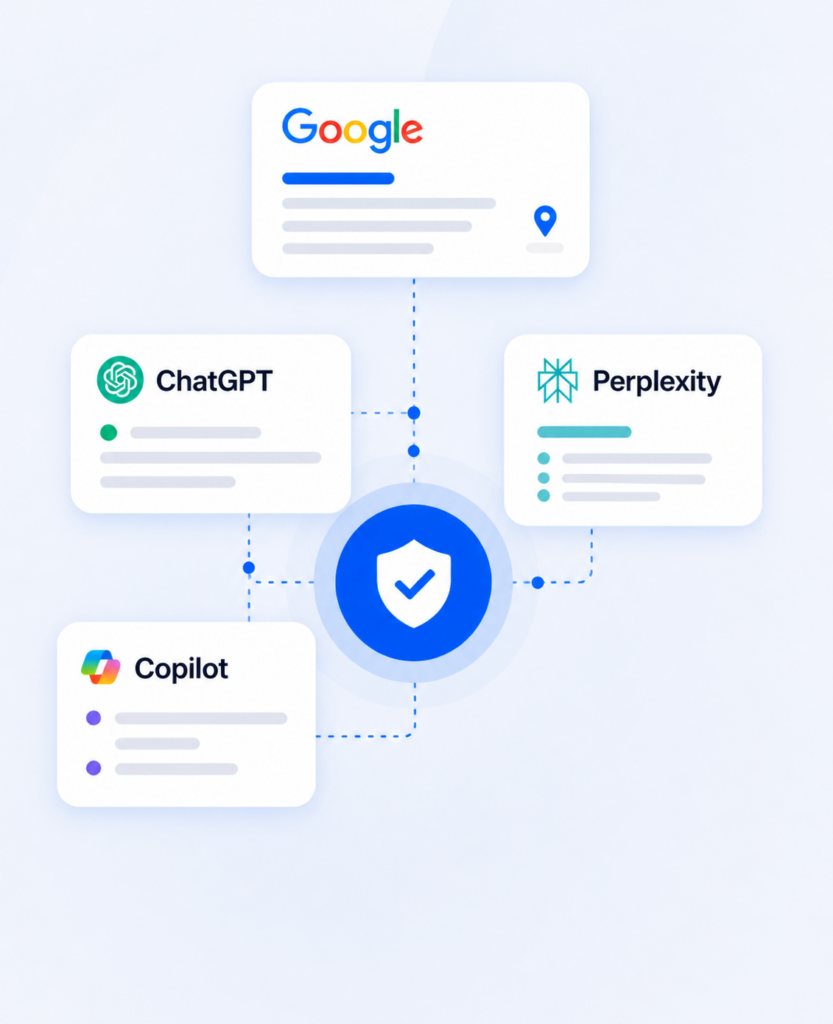

A patient does not need to browse six clinic websites anymore to narrow down a decision. Google’s AI features are built to give faster summaries with links to supporting pages, and AI Mode is meant for nuanced comparisons and follow-up exploration. ChatGPT Search can search the web, add citations, and use location signals to return more relevant answers. Copilot Search is designed around summarized responses with cited sources. That changes the moment where trust is formed. Your clinic is now being judged inside an answer layer, not only inside a traditional ranking report.
In healthcare, those questions are rarely simple. They tend to sound more like a real person thinking out loud: who is worth trusting, which clinic is nearby, who seems experienced, who treats my concern, which option feels safer, and who other people appear to recommend. AI systems are especially useful for the kind of complex, multi-part questions that once required several searches and comparison steps. That is precisely why clinics can no longer treat AI visibility as someone else’s category problem.
A great clinic can still disappear in this environment. Not because it lacks skill. Not because patients would not choose it. But because the clinic’s digital footprint is fragmented, unclear, thin, contradictory, or too weak to become part of the most trusted source set AI systems pull from. This is where SEOEchelon comes in. We turn scattered visibility into a cleaner, stronger story that machines can read and people can trust.
We do not build this service around made-up vanity prompts. Ahrefs explicitly says it uses search-backed prompts derived from what people actually search. Semrush weights share of voice by prompt volume. Chatbeat leans into question discovery and search volume across AI chatbot queries. That is the right model. For clinics, the audit should begin with real patient-intent prompts that mirror how people compare care, specialties, locations, urgency, trust, and fit.
The first prompt groups we would usually test are:

This matters because Google says AI Mode is especially useful for complex comparisons, and ChatGPT may rewrite and localize queries to improve relevance. If the wording patients use in real life is not reflected in your pages and surrounding source ecosystem, your clinic becomes harder to retrieve and harder to recommend.
direct recommendation prompts tied to specialty or treatment area
local recommendation prompts that combine service plus city, neighborhood, or “near me” language
comparison prompts that place your clinic beside named competitors or broad alternatives
trust prompts built around reviews, experience, bedside manner, or credibility
fit prompts around patient type, treatment need, urgency, or common qualifiers
fit prompts around patient type, treatment need, urgency, or common qualifiers
brand prompts that measure what AI says when a patient asks specifically about your clinic by name

This is not a trick service. It is a signal-strengthening service.
Google says there are no special requirements for AI Overviews or AI Mode beyond strong SEO fundamentals. Pages need to be indexed, eligible for snippets, internally connected, textually clear, and supported by structured data that matches visible text. Google also recommends keeping key profile information current. OpenAI says that if you want to appear in ChatGPT Search results, you should allow OAI-SearchBot and make sure your site infrastructure is not blocking it. Those are the kinds of foundational issues we address first, because they affect whether your content is even eligible to become part of the answer set.
From there, we move into clarity. We tighten provider pages so expertise is obvious. We rebuild service pages so they answer the questions patients actually ask. We improve location pages so geography, availability context, and service relevance are easy to understand. We connect important pages with internal links so your site reads like a system rather than a pile of pages. We make sure vital information is available in plain text, not buried in design elements, broken tabs, or thin templates. These are not glamorous fixes, but they are exactly the kinds of improvements that make a site easier for both search engines and AI systems to understand.
Then we strengthen the source layer around your site. Meltwater’s framework is useful here: AI systems synthesize from news, reviews, forums, structured data, and other external signals, not only from your own domain. In practical terms, that means we look at the third-party references shaping your clinic’s narrative. Which sites are reinforcing your authority? Which sources are missing? Which outdated or weak references are crowding out your best pages? Which trust cues are visible enough to support a stronger recommendation?
By the time this work is done well, your clinic should be easier to crawl, easier to cite, easier to compare correctly, and easier to trust. That is the real job. Not gaming a robot. Building a cleaner digital footprint that holds up under AI compression.
Most clinics do not have an “AI problem.” They have a page architecture and source-consistency problem. Once AI is layered on top, the weakness becomes more visible.
The first assets we usually review and improve are:
your main specialty and service pages
doctor and provider bios
location pages for each office or service area
your About page and practice story
Reputation Signals That Build Trust
contact, appointment, and conversion paths
Accurate Profiles & Consistent Citations
Articles That Answer Pre-Visit Questions
Google says AI features can surface a wider and more diverse set of helpful links than classic search, and that important content should be available in textual form with strong internal linking. That is a major clue. A clinic cannot expect one homepage and a thin service list to carry the whole burden. The stronger play is a network of pages that each answer a precise layer of the decision journey.
That is why this service often pairs naturally with your existing SEOEchelon offers around patient visibility, a patient-ready website, reputation strengthening, and clinic growth assessment. AI visibility works best when the rest of the digital foundation is not fighting it.
Most companies in this space sell dashboards. That works for software but not for clinics that need real patient growth. Tools can show reports, alerts, and data, but even Neil Patel notes they can’t replace real SEO strategy.
With SEOEchelon, it’s hands-on. We handle the diagnosis, cleanup, page strategy, content, and authority signals so you’re not left with a scorecard, but real improvements that drive results.
A strong engagement can include:
a baseline audit across agreed AI platforms and patient-intent prompt groups
a visibility map showing where your clinic appears, where it is absent, and how competitors are framed
a cited-source map that shows which pages and domains influence answers about your category
technical cleanup around crawlability, indexing, snippet eligibility, internal links, and bot access
page rewrites for core service, provider, and location assets
content expansion so your site answers more of the real comparison questions patients ask
structured data review to ensure it matches visible text and supports entity clarity
business profile and citation consistency work where needed
source-building recommendations so your authority is reinforced beyond your own domain
monthly monitoring with business-facing commentary, not just screenshots
That is a service page clinic owners can understand. It moves the conversation away from abstract AI jargon and toward the real question: what changes on the website, around the brand, and inside reporting so the clinic becomes easier to choose?
Healthcare is not a category where careless summaries are harmless. If an AI answer gets your services wrong, compresses your differentiators poorly, leaves out your strongest trust signals, or overstates a competitor beside you, that confusion shows up in patient hesitation. In some markets it also affects higher-value consultations, second opinions, elective care, and multi-location growth.
That is why this page should speak directly to practice owners, directors, and growth-minded clinicians who already know they are good at care but feel that the web does not represent them clearly enough. The pain is not vanity. The pain is hearing “we found another clinic first” when your team should have been part of the first serious shortlist.
This service is especially useful for clinics that have one or more of these conditions:
And it needs to be said plainly: we do not promise guaranteed placement in AI answers, because the platforms themselves do not promise that. We promise disciplined work that makes your clinic more eligible, more understandable, more credible, and more measurable inside this new discovery layer.
This page should not end with abstract visibility language. It should close the loop with measurement.
Google says traffic from AI features is reported inside Search Console’s overall Web search data, and it says clicks from AI Overviews have been higher quality, with users more likely to spend more time on-site. OpenAI says publishers who allow OAI-SearchBot can track ChatGPT referral traffic through the utm_source=chatgpt.com parameter. That means there is already enough technical groundwork to measure more than vague awareness. We can track discovery, engagement, assisted conversions, and the pages that actually participate in AI-shaped journeys.
The reporting layer should focus on signals a clinic can act on:
That kind of reporting is useful because it tells your team what changed, why it changed, and what needs to happen next. It also keeps the service grounded in growth rather than novelty.

When patients ask AI who they should trust, your clinic should not be vague, buried, or missing. It should be clear, credible, and easy to recommend.
If your practice is ready to stop losing attention before the first click, AI Visibility for Clinics gives you a practical, measurable way to strengthen discovery where modern patient research is already starting.